
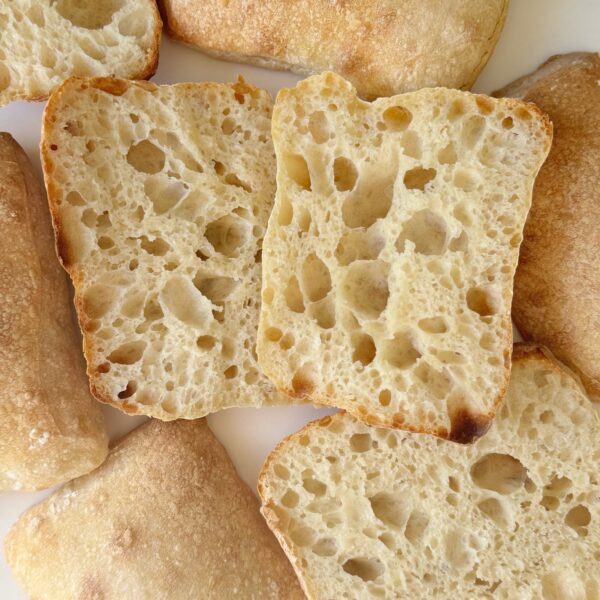
Sourdough Ciabatta Bread
This sourdough ciabatta bread recipe is made with traditional techniques and simple ingredients. Perfect for dipping or filling with your favorite ingredients.
Servings:
8
rolls
Equipment
- Mixing bowl
- Baking sheet
- Parchment paper
- Bench scraper
- rectangle proofing container
- Food scale
- Silicone scraper tool
Ingredients
- 100 grams active sourdough starter
- 385-400 grams water (see notes)
- 500 grams bread flour
- 10 grams salt
- 5 grams olive oil ((optional))
Instructions
Mix the dough
-
In a mixing bowl, dissolve the sourdough starter in the water. Stir using a fork.
-
Then, add the flour, salt, and olive oil (if using), and mix until the flour has absorbed all the water. This is best achieved with a silicone spatula as the dough will be very wet.
-
Cover the bowl with plastic wrap and let it rest for 30 minutes.
Stretch & Folds
-
After the dough has rested, work the dough into a ball by folding it into itself a few times. Tip: wet your hands to avoid the dough from sticking.
-
Then, perform your first stretch and fold. Take a portion of the dough, stretch it up a few inches, and fold it to the opposing side. Rotate the bowl and do this to all 4 quadrants of the dough.
-
Once complete, cover the mixture.
-
Perform 3 more stretch and folds in 30-minute increments.
Transfer the dough to the proofing container
-
After all 4 stretch and folds have been completed, transfer the dough to your rectangular proofing container. Anything around 8.5 cups will work.
-
Mark where the dough sits and cover the dough with plastic wrap.
-
Once the dough has increased in volume by 50-75%, cover it and transfer it to the refrigerator for 8-36 hours.
-
For the dough to increase by 50-75%, it can take anywhere from 5-8 hours depending on the temperature in your home. Mine took 6 hours @ 70 degrees F.
Shape the dough
-
The following morning, remove the dough from the refrigerator and line a baking sheet with parchment paper. Additionally, spray a little non-stick oil on the parchment paper.
-
Liberally flour your work surface and the top of the dough. It is a sticky dough, so don't be shy about using enough flour.
-
Using a silicone scraper tool or silicone spatula gently loosen the sides of the dough from the container.
-
Then, invert the container onto the work surface and allow the dough to naturally fall out.
-
Sprinkle flour over the entire surface of the dough and gently pat the dough into a 14x9 rectangle.
-
Then, using a bench scraper cut the dough into 8 pieces. I draw lines down the dough using flour to help guide me on where to cut.
-
Place each piece of dough onto the baking sheet about an inch apart, sprinkle with a little flour, & cover it with oiled plastic wrap or a large proofing bag. Let them rest for 1-2 hours or until they puff up a bit.
Bake the sourdough ciabatta bread
-
When ready to bake, preheat your oven to 475 degrees F and bake for 10 minutes. Reduce the temperature to 450 degrees F and bake for 8-10 minutes more or until the bread starts to brown.
-
Remove from the oven and allow the bread to cool for 1 hour before cutting into it & enjoy!
-
Any leftover sourdough ciabatta bread can be stored in an airtight continer or bread bag for 3-4 days on the counter.
Notes
Baker's schedule: feed your sourdough starter the evening before you mix the dough. Mix the dough early in the morning (8 AM) to bake for the following day.
Hydration: This recipe can be done with 385 grams of water or up to 400 grams. You may want to start with 385 and then work your way up. Either way, the result will be lovely.
