
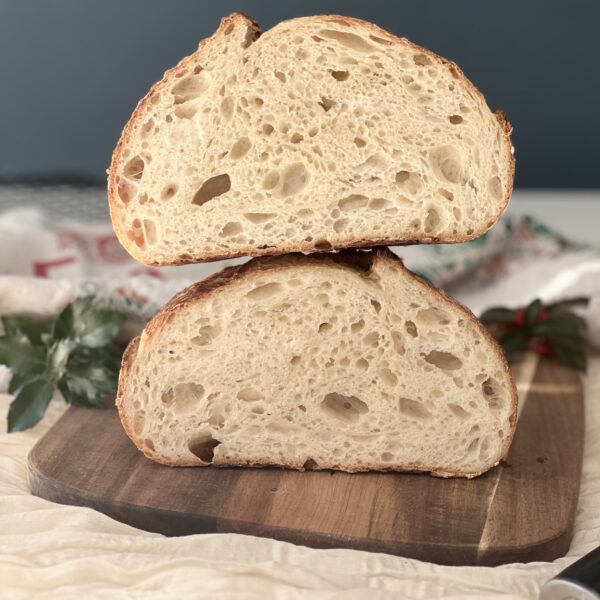
Sourdough Bread (with a sweet levain)
This artisan sourdough bread is crafted with a unique sweet levain making it well fermented, but with a classic mild flavor.
Equipment
- Dutch oven or cast iron
- Mixing bowl
- Bench scraper
- Scoring tool or sharp knife
- Food scale
- Parchment paper
- Banneton Proofing Basket
Ingredients
For the sweet levain
- 10 grams active sourdough starter
- 40 grams water
- 40 grams all-purpose flour
- 20 grams sugar
For the dough
- 80 grams sweet levain (from above)
- 328 grams water
- 450 grams bread flour or a strong all-purpose flour
- 9 grams salt
Instructions
Make the sweet levain
-
The evening before you plan to bake add the sourdough starter, sugar, and water to a clean jar. Stir until the starter and sugar dissolve and the water becomes milky.
-
Next, add the flour and stir until there are no dry bits of flour left. Loosely cover the jar and allow the levain to rest for 12-13 hours.
Mix the dough
-
After the levain has doubled in size and is bubbly, prepare to mix the dough.
-
To a mixing bowl add the water, and all of the sweet levain (should amount to 80 grams) there may be extra stuck to the sides of the jar, try to keep it no more than 90 grams. Stir with a fork until the levain has dissolved.
-
Add the flour and mix until all of the flour has absorbed the water. We are purposely leaving out the salt during this phase.
-
The dough will be wet & shaggy. Cover it with plastic wrap or a damp towel and allow it to rest for 30-45 minutes.
Add the salt
-
After the dough has rested sprinkle the salt over top of it and dimple it into the mixture.
-
To ensure the salt gets mixed in and to create some strength in the dough, fold it into itself repetitively & slap it against the bowl for a few minutes.
-
The dough will appear smoother, but still quite sticky. This is normal. Cover the bowl with plastic wrap again and let it rest for 30 minutes.
Coil Folds
-
Coil folding is a technique used in sourdough bread making to strengthen the dough and improve its structure. I prefer this method for this recipe as it is a softer approach to this delicate bread. Tip: lightly wet your hands to avoid the dough sticking to them.
-
Gently reach under the dough with your wet hands and lift it up.
-
Stretch the dough upwards, then fold it under the center of itself.
-
Turn the dough 90 degrees and repeat the lifting and stretching process.
-
You can continue to turn the dough and fold it a few times, usually 4-5 times in total, to make a complete “coil.”
-
Once complete, cover the dough and allow it to rest for 30 minutes.
-
Perform 4 more coil folds within 30-minute increments totaling 5 coil folds. This will ensure the dough develops enough structure.
-
Once all coil folds have been completed, cover the dough and allow it to rest for the remaining bulk rise (approximately 3-4 more hours).
Pre-shape the dough
-
After the dough has rested for at least 7-8 hours total, it can be pre-shaped.
-
Place the dough on a lightly floured surface and create a round shape by using your bench scraper.
-
To create a round shape place the bench scraper under the bottom part of the dough and use a circular motion. Do this repetitively until you get the desired shape. The tension will naturally settle in the middle of the dough, giving it a better oven spring when baked. You can also do this motion using your hands.
-
After a round ball shape has been created, cover the dough with a towel or bowl and let it rest for 15 minutes.
Final-shaping
-
When it comes to the final shaping, you have the choice of creating a round boule or an oval batard.
-
After shaping, position the dough in the banneton basket with the seam facing upwards. If necessary, you can gently stitch or tighten the seams while in the basket.
-
Now, cover the dough either with a cloth or by placing it inside a 2.5-gallon bag. Then, transfer it to the refrigerator and let it rest for 12-18 hours.
Score & Bake
-
For an optimal rise, I recommend preheating the oven to 500 degrees F for 30 minutes with the baking vessel in there.
-
When ready to bake, remove the dough from the fridge and invert it onto a piece of parchment paper.
-
With a sharp knife or bread lame score 1 slightly curved line down the dough.
-
Transfer the dough to the Dutch oven using the parchment paper and bake covered for 20 minutes at 500 degrees F. Optional: place 2 ice cubes into the dutch oven to create steam.
-
After 20 minutes, remove the lid, decrease the temperature to 450 degrees F, and bake for another 15 minutes.
-
Allow the bread to cool completely before slicing into it (about 1-2 hours).
-
Sourdough bread lasts 2-3 days at room temperature and stores well in a paper or plastic bag.
Notes
Baker's schedule:
1. Mix the sweet levain the evening before mixing the dough and allow the levain to ripen for 12-13 hours.
2. Mix the dough the following morning. The first bulk rise will be 8 hours at room temperature.
3. Cold-proof or refrigerate the dough for the second bulk rise for 12-18 hours (overnight) baking the bread immediately following this.
This sourdough bread recipe was tested at 68 degrees F and required 8 hours of its first bulk rise. If your environment is warmer than this, it may not require as much time. If it is colder, it may require more than 8 hours. Watch the dough, not the clock.
Nutrition
Nutritional information is automatically calculated and should be used as an approximation only.
